
"I am on my own and there are three hundred guests"
Seating is automatic: one click and every guest sits where their rank puts them. One person can prepare a ceremony with several hundred guests and still have time left to check it.
CerimoniereWeb is order of precedence software for protocol offices. Pick the branches of the protocol you want to invite, send the invitations, and it seats everyone in the right order. When someone turns up who was never on the list, it reworks the plan instead of making you redraw it.
Request a demo Download the brochure
Twenty years of ceremonies, from a council chamber of forty seats to an international event with several thousand guests.
In use at
Twenty years of ceremonies: from a council chamber of a few dozen seats to an international event with several thousand guests.
No general order of precedence sets the internal order of a university: the rector or vice-chancellor, pro-rectors, deans, heads of department, the senate and the governing body follow the order the institution has set for itself. You define it once as your own protocol and apply it alongside the civic one for the external authorities seated in the front row.
Five universities already use it: Piemonte Orientale, Cagliari, Stranieri di Siena, Tuscia, Molise.
Forget
the seating plan drawn on A3 paper, the sticky notes on the whiteboard and the spreadsheet where every change is redone by hand.
With CerimoniereWeb, the night before the ceremony you are not redrawing the plan. You are checking it.
In twenty years we have seen all of them, most of them more than once, and usually because a protocol office told us. Every one of them is the reason a feature exists.
Seating is automatic: one click and every guest sits where their rank puts them. One person can prepare a ceremony with several hundred guests and still have time left to check it.
People and offices stay up to date in their own registry, and a new event is cloned from one you have already run. Last year's national day is all still there: the plan, the guest list, who actually showed up.
Add someone to a hall that is already full, even after the ceremony has started, and CerimoniereWeb reorders the seats by office, appointment and rank. Anyone who must not move gets pinned, and stays put.
With the invitation portal each guest gets a personal link and answers for themselves: accept, decline, name accompanying guests, appoint a representative. No account to create, and you watch the replies arrive.
Two official protocols ship with the software. Alongside them you define your own: academic bodies, civic offices, the appointments inside your institution. As many as you need, with no limit.
Whoever is on the door searches for the guest, or scans the QR code from the app, and sees the assigned seat straight away. Meanwhile a dashboard shows arrivals, absences and how fast the hall is filling.
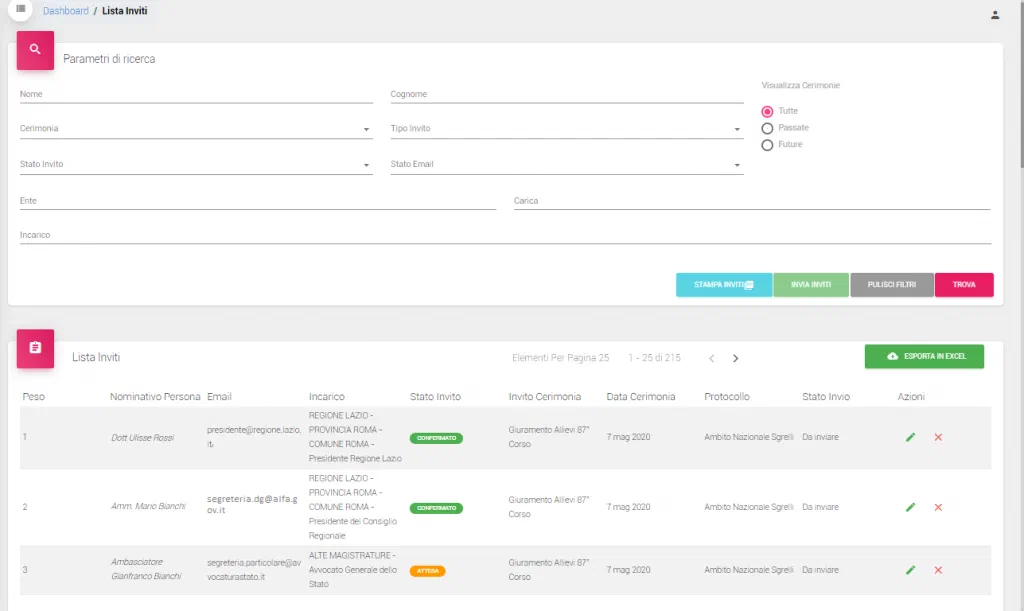
CerimoniereWeb also produces the invitations themselves: cards, a pre-printed opening line or one written by hand, according to the standing of each guest.
Invitations go out by email too, and the follow-up is handled from there: the guest who cannot attend and sends a representative in their place, and the people arriving alongside them.
An accompanying guest nobody mentioned, a seating instruction that lands late: those are the most common reasons a seat gets disputed, and CerimoniereWeb absorbs them without you having to rebuild the hall.
Protocol offices have no shared standard between them. Each one has built its own methods and its own tools, and in plenty of them the seating plan is still drawn by hand. It costs time, and nothing survives of the ceremonies already held.
CerimoniereWeb orders by category, subcategory, office, appointment, rank and seniority. Those are the criteria every order of precedence is written with, not just the Italian one, which is why the same engine handles a diplomatic reception and a graduation ceremony.
Vienna Convention on Diplomatic Relations, 1961
Heads of mission ranked by class and by the date they presented their credentials, delegations ordered by the name of the state, the dean of the diplomatic corps at the head of the list. All of it is an ordering like any other: you declare it once and every ceremony that uses it inherits it.
Configured at onboarding
Official and civic orders of precedence
Lord-Lieutenants, High Sheriffs, the Lord Mayor and the civic party, alongside visiting national office holders. Civic precedence varies by county and by occasion, so it is modelled as a protocol of its own rather than assumed.
Configured at onboarding
State Department order of precedence
Federal, state and municipal office holders in a single ordering, with the flag and general officers of the uniformed services ranked by grade inside their appointment.
Configured at onboarding
Real Decreto 2099/1983, Ordenamiento General de Precedencias en el Estado
The Crown, the three hierarchies of the State, the autonomous communities and local government, the article 3 split between actos de carácter general and de carácter especial, and article 13, which ranks regional presidents by the publication date of their Statute. Each case becomes a protocol of its own.
Configured during onboarding
Decret 189/1981, de 2 de juliol, amended by Decret 459/1981
Actes de caràcter general and especial, local corporations ranked by territorial category and then by population, and the place article 13 reserves for the mayor of Barcelona. When State authorities attend, Real Decreto 2099/1983 applies as well: two orders in one ceremony, here two protocols applied together.
Configured during onboarding
Décret n° 89-655 du 13 septembre 1989
The article 3 order for the departments, from the préfet who represents the State to members of parliament, council presidents and the maire, is modelled with the same categories and subcategories. Paris and the overseas territories, which have orders of their own, become separate protocols.
Configured during onboarding
D.P.C.M. of 14 April 2006, amended 16 April 2008
The national and territorial protocols are built and shipped with the software, from the President of the Republic down to brigadier generals. This is the one we have maintained at legal depth for twenty years, and it is the proof that the engine goes as deep as a statute requires.
Ships with the software
Configuring a new ordering is part of onboarding, and we do it: we work from the legal text and from how your office actually applies it. Whatever the statute leaves out, such as academic bodies, internal appointments or guests with no office at all, goes into custom protocols, and those are unlimited.
One of many, and one of the largest. Cerimoniere ran the opening ceremony at the Foro Italico: seating in the stands and the invitations, with the President of the Republic and the international delegations among the guests. Seventeen days of competition, at one of the biggest sporting events Italy has ever hosted.
The details of the people you invite already exist somewhere: a spreadsheet, an old database, a Word list somebody has kept current by hand for years. That is where onboarding starts.
We take the data you use today, in whatever shape it is in, and load it into the CerimoniereWeb registry. Nobody retypes anything.
The plan of your hall, the offices in your institution, the precedence rules you apply. It is all there when you first log in.
Invitation templates, printed output and the integrations your office does its own way.
Precedence rules change with whoever is hosting. Here is how CerimoniereWeb applies to the five cases we meet most often.
Opening of the academic year, graduation ceremonies, honorary degrees. Academic order is in no statute, so you define it.
See how it works for a universityCouncil installations, civic commemorations, freedom of the city. Territorial and civic precedence, alongside the visiting authorities.
See how it works for a councilCredentials, national days, passing-out parades, changes of command. Where rank decides, the ordering follows rank.
See how it works for a commandGeneral meetings, annual reports, foreign delegations. The board of a bank holds no public office, and still has to be seated in order.
See how it works for a bankAdmission ceremonies, general meetings, opening of the legal year. Robes and civil authorities in the same room.
See how it works for a professional bodyWe will show you CerimoniereWeb in use. If you go ahead, we configure the plan of your hall and your order of precedence ourselves, and we build the customisations your office needs.
We would like to know which pages are read, and in which language, so we can write the right ones. The tool we use is our own, the data stays on European servers and goes to nobody else. Without your consent the site works exactly the same, and we store nothing on your device. How it works in detail